On Managing and Leading

Ben Horowitz said something like this when talking to Tim Ferris, and I’m not sure if I caught the essence exactly, or maybe I edited it a bit, but here’s what resonated:

paper boats on solid surface
Photo by Miguel Á. Padriñán on Pexels.com

A manager is someone who teaches others how to do what they know

A leader is someone who teaches others how to know what to do

My add: The key to being effective is to know when to manage and when to lead


Directional credit to The Tim Ferris Show: Ben Horowitz – What You Do Is Who You Are >> Lessons from Silicon Valley, Andy Grove, Genghis Khan, Slave Revolutions, and More

Color me mine

I wrote this back in 2015 and like many written doodles, it got filed away and not shared.  I found it today and thought why not now…

Color me mine

My eyes are green, because hazel is bland

And blue is bright

But mine are not bland nor bright

They are muted, and you wouldn’t see them except for the sharp gray that outlines them

Just because they are green, don’t think that you are better

Don’t think that I think you are worse

Don’t tell me I don’t know what it’s like to have brown eyes or blue, because I know I don’t know what it’s like

But that doesn’t mean I don’t know it’s not fair that someone treats you different because you have brown eyes

Just because I don’t have brown eyes doesn’t mean someone doesn’t treat me unfairly because of my blonde hair

And it doesn’t mean that I am not pained by the way they treat you

I am sickened by the actors who think they are better

And I am sickened by you who also think you are better

We’re all supposed to be human, not knives nor missiles, not scorecards nor belt notches

And I’m sorry, so very very sorry that not everyone feels the same way

But I ask that you remember that not everyone feels the same way

Because I am proud my mom has brown eyes

And I’m grateful for the lessons that she taught me

And I’m proud my daughter has bright blue eyes

And I hope to teach her lessons about what I’ve learned having muted green eyes

One day we will all see through brown eyes, and blue, and green and we will see each other for the decisions we make and the actions we take

I hope you do not hate me for mine

I want to love you for yours


Love,

Shanda

Giving tree

You want more out of life?  Give more.

Giving Tree

But you don’t have to give money, you can give time.

But I’m exhausted.  I don’t have any time to give.  You don’t?  Look at those priorities.

And here’s the MintROI Tool #9 Whatever is getting your time, is where your priorities lie.  For a lot of people, the money part is pretty evident, but the time part is surprising.  If you’re anything like me when I first figured this out, I went straight into denial.  Surely my family was more important to me than my work, yet my work was taking much more of my time.

Guys, we have 24 hours in a day.  168 hours in a week.  Let’s say we work 45 hour work weeks, 123 hours left.  And sleep is super important, so that’s 8 hours a night.  67 hours are left.  And subtract 20 hours for eating and grooming…that’s 47 hours you have left to do whatever you prioritize…do you realize that’s a whole other work week?

Where is your time going?  It’s going to whatever you prioritized.  Is it Facebook?  Is it TV?  Is it writing a blog?  Maybe you commute, maybe you have soccer practice, maybe you run errands, maybe you have a second job.  I’m not saying any of these are bad or good.  You have to actively decide what is right for you.  My point is that we need to be as aware of our time spend as we are of our financial spend.  More so even.

How we are spending our time is a leading indicator of our happiness.  If we are spending our time doing the things we love, we are more likely to be happy.  If we are spending our time doing things that are emotionally neutral, or even draining, of course we’re going to be exhausted.

MintROI Tool #10 Giving back in a way that you want to give actively puts you in a positive state.  It actually gives you energy.

Do you know the one thing that you get more of the more you give? Love.

Love makes us feel good, and the more we give it away, the more we feel good.

So let’s go back to that 47 hours – maybe you’ve chosen some pretty important priorities.  If you’re married, does your spouse have the best of you, or do they have your left overs?  If you have kids, do they have your attention?  Can you help mentor another at work, can you offer to do the lunch run?

There’s a lady at my office – Nastassia – who is very busy, yet every time I go to check on her she always asks me what she can do for me.  Can you believe it?  This crazy busy person always stops and asks ME how she can help me.  Now let me tell you, if Nastassia EVER has something she needs my help on, you know I’m going to go out of my way to help her.

But I don’t know you, and maybe you’re the employee who always asks what else they can do, and always says “yes” when asked.  And that’s why you’re soooo busy.  Rather than celebrate your generosity, maybe your boss always tasks you with more because you can take it.  Maybe you think they walk all over you.

Listen, no one wants to be used.  So two things here.  First off, as a manager, I will tell you it’s true.  I tend to give more to those who have proven successful at taking more.  But those are the first people I consider when it’s time to give merit increases.  Those are the ones that get the most experience and the best projects.  Those are the ones who eventually become leaders in their own areas.

But you’re right.  No one wants to be used.  And so when you’re thinking of what to give, I ask you to consider giving the gift of honesty.  If someone is using and abusing your kindness, let them know.  Heck, if you need help, let them know.  Sometimes being honest and true, revealing what we think is a weaknesses to others, we are actually giving the most important thing of all – we are giving of ourselves.

So today I’m going to ask you to give it a shot with me.  If you need more, give more and see what happens.  Let me know!

Diversify me


One of my ‘friends read my post Earn What You’re Worth and she said that she agreed with some and disagree with other parts.  That’s exciting!!

Thought Diversity Image

Hey, not everyone is going to agree with me, and that’s OK!  I embrace others’ opinions because they’ve had different experiences than I have.

I love love love that she’s comfortable enough in our friendship to share her honest opinions.  Actually, this is a MintROI Tool #8 – Embrace thought diversity

Thought diversity is not new to the workforce, it’s been around for several years.  A 2013 study published by Deloitte “Diversity’s new frontier: Diversity of thought and the future of the workforce”  outlines the benefits of thought diversity and how to achieve it.  Among the benefits, it lists guarding against group think and expert overconfidence as well as increasing insights.  The study also suggests that to create diverse thought in an organization, you should hire differently, manage differently, and promote differently.  What this study, and others like it, asked us to do was effectively move away from a “more like me” mentality, towards a “complement me” mentality.

When I took over my current team, one of the first things I did was create an environment where it was safe for each team member to have their own opinion.  And why wouldn’t I?  I’m not always going to be the smartest person in the group.  Neither is Jainey, neither is Sam, neither is Manish.  We’re all going to take turns being the smartest one, because of the various experiences we’ve had.  So why wouldn’t I want to benefit from someone else’s wisdom?  I can’t do that if my team members don’t feel like they are allowed to have a voice.  If I shut them down every time they disagree with me, they will quickly learn never to speak up.

Have you ever heard a boss or person of authority in business say, “this is not a democracy”?  I have, and it urked me to the core.  First off, I thought a democracy was a good thing.  The leaders who used that term wanted to shut down team conflict quickly and lead by a strong arm.  That taught the team it was not ok to disagree with the boss, regardless of what you really thought about their direction.  That ultimately caused a dis-empowered team and led to a lot of internal negative talk among the staff outside of team meetings.  Leaders need to understand that the same logic we apply to companies about their employment brand, also applies to leaders about their own brand.  The conversation is going to happen with or without them.

I’ve been in teams where people think they are supporting open conversation, but they aren’t.  This happens when the manager doesn’t acknowledge the value of an idea, and instead jumps straight to why it won’t work.  The intent is to be collaborative, oh sure, the manager will ask for ideas and opinions, but they will inadvertently shoot them down.  Because of the manager’s experience, insights, exposure to the broader picture, they foresee immediately whether an idea might not work out.  Instead of valuing the idea, they want to show the team why they are in the lead role.  They may even explain why it won’t work in great detail, which I’ll admit, is better than some managers, but they forget to validate and reward the courage of the individual who shared the idea.  There’s a simple way to combat this.  It takes two steps.

Step 1: Acknowledge the value of the contribution.  Something like “great idea” or “thanks for sharing your idea”.

Step 2: Decide whether there’s more harm in letting the idea play out, or more harm in stopping it.  The way I see it, if I refute the idea right away, the employee doesn’t feel appreciated, and may not be so keen to speak up next time.  But if I let them try it, then they may learn on their own a different lesson.  Or I could use the team’s feedback to help steer by saying “great idea.  Does anyone have anything to add to it?”  Or I could decide that allowing the idea to play out will hurt us (lose time, lose resources, create a detriment to credibility).  If that’s the case, I’ll explain the why.  I am the boss (love that!) so I get to decide, but I’m not so authoritarian that I believe people should follow me just because I said so.  You know what kind of boss works that way?  A boss of “yes men” (and women).  You know what yes men are?  Unempowered, unthinking, and unremarkable.

Starwars Clones

I kind of think of the Star Wars Clones as yes men.

Individually, they are pretty unremarkable.  Together, they are very powerful, but that doesn’t change the fact that they are fighting for the wrong cause.


My team is empowered, brilliant, and beyond remarkable.  We do remarkable things.  But that’s not because I’m particularly remarkable.  It’s because they are, and I’ve created an environment where they have room to shine.

Recently, my team and I were discussing some new assessments that were being offered by my place of employment.  It was an offering we were selling to our clients, so we had to understand how it worked.  So I suggested we all take a training on it.  One of my team members suggested that we take it a step further and all take the assessment ourselves and then receive our own results.  I’ll admit, I was not excited.  I had taken numerous assessments that I thought provided the same analytics that this one did, so I was not personally keen on taking another one.  I also didn’t see how taking the assessment was going to help us bring value to our clients.  However, instead of dismissing it right away, I applied the two steps above.  Step one, I told her it was a great idea.  I valued that my employee gave a suggestion that they thought would benefit the team.  Step two, I decided that it would not hurt to let the team spend an hour on it and it wouldn’t take much effort from my side to figure out how to get it initiated for us.  So I let it play out.  You know what?  I was glad I did.  First off, I had a whole new experience in taking the assessment.  By having my employees take the assessment, they could give our clients a first hand account of what it was like.  And when the results came in, the results taught me something about my team.  It showed tons of diversity in drivers and motivators, as well as diversity in traits. Does this mean the assessment is wrong?  No.  The assessment was dead on.  I agreed with all of the insights it provided me about each individual, and what was beautiful about it was how we complement each other.  We naturally are drawn to certain people on our team to create visually appealing presentations, and others to provide engaging training, and others ferret out the right level of details to put in process maps.

Now, when I look at our assessments for new hires, I look for someone who’s going to fill in a gap on my team.

So coming back to my friend disagreeing with some things in “Earn What You’re Worth”, she’s absolutely right!  She said that some companies are not growing, they’re shrinking.  In companies like these, there truly is limited promotional opportunities.  I 100% agree.  There are some cases where no matter what you do, you won’t get a promotion because there’s no room for advancement.  For those people, I’m sad that they feel stuck in that environment, for whatever reason they are staying there.  Fortunately, that’s not the audience I was writing to.  I made a mistake of not clarifying my audience in my article.  And so now she’s taught me a valuable lesson, to give more thought to my own limitations in thought, and to address those when I can.

When I think about how to read this article for my own limitations, I see it’s very hard.  While I can see that you don’t want to spin into oblivion not making a decision because people don’t agree (for those situations, I feel strongly there is a point where the boss should step in and lead), and I also see a potential for people to think I’m embracing conflict, I’m not.

Thought Diversity Dilbert

I love this cartoon from Dilbert because it shows that thought diversity is not easy.  To embrace it, you’re giving up your right to be right all the time.

But still, I’m not sure I’ve exhausted the ways others will disagree. You see, I’m writing using my experiences and the books and articles I’ve read.  But I don’t yet have an editor or beta test audience sharing their opinion or experiences for feedback before I publish this.  (It’s the power of Yet, Baby!)

I’m looking forward to the day when I can get more thought diversity into the MintROI Toolkit.  If you’re interested in helping, let me know!!

Momentum this

An object in motion stays in motion.

Momentum is so powerful, it might as well be up there with the great super powers of flying, super strength, the lasso of truth, and even laser vision.

MintROI Tool #7 : Get moving now

  1. It doesn’t really matter what your goal is, but make a goal. That’s step one.
  2. Next, make your goal specific and measurable. This may take several renditions, and that’s OK.
  3. Next, determine what it takes to achieve your goal.
  4. Next, determine how you do that. Work your way backwards until you get to the smallest next step that’s very reasonable to take.
  5. Gain momentum. Start with the small steps and chip away at them every day until you’re rolling and grooving.  Before you know it, you’ll have reached your #1 goal.


Examine this in action

Step 1: Start with a goal

I have a goal to help others <–Super awesome, but also vague and who knows when I’ll achieve this

Step 2: Make that goal very specific

I have a goal to provide others with information that the outside world may not be providing them <—A little more concrete, but still pretty vague

I have a goal to run a blog where people can find life hacks <–getting there

I have a goal to run a blog where people can find timeless life lessons or “tools” that help them succeed at work <–much better.  Still could use some work, but I’ve achieved step 2 and can always continue to refine another day.

Step 3: What do I need?

To do this goal, I need

  • Write blog-worthy articles
  • Set up a blog site
  • Get an audience
  • Make this sustainable

Step 4: Break it down to the very next step

If I need to write blog-worthy articles, I have to start with writing articles in general.  Maybe I need to start with something even smaller, a list of ideas to write about.  I need to practice writing.  I need time to write.  I need a computer (or a pen) and blank paper.  I need to type my first word.  Now.

Step 5: Harvest the power of momentum

Here’s the magic step.  Now I have to create a habit out of all the very next steps so that I can build it into my everyday life.  For my sub-goal of writing, I’m going to schedule time to write 500 words a day.  I could have said 1000.  I could have said 100.  What’s important is that I am doing this action daily.

That makes Shanda, writing is something you need to practice to get good.  So it makes sense that you’ll have to do it daily.  But I don’t think I could work on my goals daily.

Oh you of little faith.  Let’s rewind to step 3 and pick on something else.  What about setting up a blog.

Step 4: Break it down to the very next step

To set up a blog, I need to know what a blog is.  I need to look at my options for creating a blog.  Do I build a website myself, do I outsource my website?  To figure this out, I need to know what it would take to build it myself (time and a lot of education in an area that I have very little experience) or outsource it (money).  I don’t have much time, so I’m going to outsource.  I also don’t have much money, so what are my options? I need to find out what those options are, but how? I need to call places.  Ok, to do that, I need to find a list of places to call.  Ok to do that I need to get on the internet and research some options.  Ok, so I need a computer and internet and time to research – that’s easy.  I can do that now.

Step 5: Harvest the power of momentum

If on the first day, I use all my time researching places.  On the next day I need to use my time contacting them.  And then comparing options.  And then making a decision.  And then acting on it.  I don’t need to do one step a day.  I just need to do at least one step every day.  There will be days when I’m enjoying what I’m doing or I have more time to do it.  On those days, I’ll do more.  There will be days when it’s hard to do anything, and on those days, I just need to do one thing.  Once I do that one thing, I rejoice because it brought me one step closer to my goal.

If you really want to achieve something, then put that something first.  That means all your other assumptions about that something and all your other competing goals out there take a back seat (time, money, family….have I hit a nerve yet???).  Don’t worry about time, the time will pass anyway.  Don’t worry about the money, it should never be your starting point.  If your goal is strong enough, the providence will come.  Don’t worry about your family (eek!!!  This one I can’t say because that’s my primary love…and I hope never again to have a goal that doesn’t put my family first).  But you get the idea.  Choose goals that align with your true top priorities then harness the power of momentum to get headed in the right direction and the rest will fall in place.


As with all things, this post didn’t come out of thin air.  Inspirational credits belong to:

David Allen: Getting Things Done

Sam Crowley http://everydayissaturday.com/

HTE 371: Improving with Actions not Tasks | Heath Armstrong https://hacktheentrepreneur.com/

Tony Robbins: Awaken the Giant Within


Play the patterns

Want your resume to be noticed by a machine? Create a pattern.

Want your resume to be noticed by a person? Break the pattern.

Mint ROI #10: Play the patterns.  Recruitment of 2017 is much like recruitment of 2007, except instead of sourcers mining the world wide web for resumes, bots are – bots with Artificial Intelligence (AI).  These bots are different from the bots of 5 years ago because they have the ability to learn which types of resumes a recruiter is interested in pursuing.  In doing so, they look for trends.

Recruiter Screen Visual

Search –> initial results –> feedback –>candidates–>call list

This works well for creating massive lists of potential candidates of which the recruiter begins calling to hone in on the right candidate.

So how do you get to be the right candidate?

First off – get eaten by the bot.  The bot has to find you.  It’s looking in all the traditional recruitment spaces, LinkedIn, Facebook, Indeed, other job boards, but it’s also looking in some of the wide-net recruitment spaces conference attendee lists, articles, company webpages.  And it’s looking in all those links.

  • Use key words and industry tag words, including synonyms – the more the merrier
  • Use clean industry-standard titles
  • Embed links to sites in your space within your resume (even if hidden), and where possible, link to your resume from as many sites as possible
  • In the white space at the bottom, or if you know how to code, embed competitors, conferences, trainings, and other search terms you’d use if trying to find your resume. Turn the words clear so that it does not appear visually to the recruiter (though if they see it, they won’t really mind…they know what you’re doing, and a smart cookie is just the kind of candidate they want to share with their client)

Now if you want to keep doing more of what you’ve already been doing – that’s all you need to do.  However, if you want to do something different than what you’ve been doing – that’s where you’ll need to break out of the box.

Embracing the pattern:

In order to change patterns, you have to first identify what pattern your resume embodies.  Have you always been in HR, Test Engineering, or Sales?  If so, chances are that’s what the resume patterns reflect.

Are you trying to get into something different?  Identify the patterns within that job family, and bring them to life on your resume.  First, to identify patterns in your perspective career, look for others in the position you want (LinkedIn is a great source!) and notate what terms are coming up over and over again.  Now go to work on your own resume.  Don’t mishear me – don’t lie about your experience!!  Just highlight areas in which your experience can cross over into your desired fields.  Here’s some tips on how:

  • Add in a brief objectives section discussing the role you’d like to obtain
  • Highlight your experience in that area, even if it’s not the bulk of the work you’ve done
  • Use the white space, clear text concept to tag your resume to terms you want the bots to pick up
  • Use alternative titles that align with that area (if you were an IT product manager, but you’d like to get into Sales, and you provided support in some sales calls, your title should read “IT Product Manager : primary role”, “Technical Sales : secondary role”. Notice the space between the colons?  Some bots would not have trouble if you left out the space because they are looking for any word that contains manager, but other bots will get messed up because they are only looking for the word “manager” not “manager:”.  You want to be picked up by all of them, so be cognizant of simply changes like that.

So now you’ve played to the patterns, you’re on your way to being picked up by the bots.  How do you stay in past the first screen by an actual human?

Break the pattern:

If you’re trying to change careers, chances are, you won’t get past the first screen on your resume alone.  They are looking for the most qualified person, and unless no one else has the experience they want, you’re not likely to be the most qualified on paper – but that doesn’t mean you’re not the most qualified.  That’s where your networking skills come into play.

Today’s typical recruiting is a numbers game.  Exceptional recruiting is still a networking game.  If you lack experience in a particular field, you won’t make it past the “similar to” profiles that funnel in experienced candidates playing the numbers game.  But, if you make the right moves, you can make it in the door with the networking game.  And by the way, this is the way you want to play the game.  Even with all the technological advances, referrals are still the number one source for hires at most companies.

Obligatory Disclaimer: Don’t expect to land a job you’re not qualified for.  If you’re not qualified, don’t even bother applying until you meet the minimum advertised qualifications.  How do you get those skills?  Take on additional side projects in your ideal area while doing your day job well. 

The good news is that companies keep these qualifications to a minimum for a reason.  There’s room for opportunity for someone like you – with a strong competency set and a vast transferrable skillset – to be considered for the role.

Here’s what I recommend:

Find others within the organization that you know and take them to coffee.  Find them through

  • Your existing friend base
  • Mutual friends
  • LinkedIn
  • Traditional professional networking groups
  • Nontraditional groups like neighborhood meetups

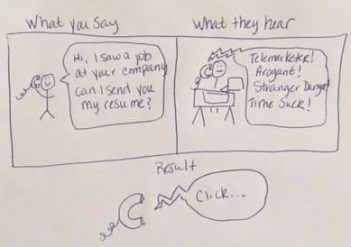
Don’t know anyone? Cold call.  But if you have to go this route, please don’t lead in with your job search and resume!!

breaking patterns in recruiting

Instead, lead in with something that makes them feel special and want to help you.  Be sincere and show interest in their company and learning more about what it’s like to work there and see if you can take 5 minutes of their time.  Ask them questions about their experience, at the end of which, if you still like the company, ask them if they can put you in touch with someone in recruitment or offer to send your resume for them to forward on to recruitment.

You’ve done that already?  Do it again.  Call the same people if you’re friends, or different people.  Call more people.  Make it a win-win.  See if there’s some way you can help them too.  They don’t have to be senior executives.  They can be in any role within an organization.  The closer to your job family, the better, but even an intern or the mailroom clerk can be a valuable resource.  Steer clear of calling the same folks everyone else is calling (recruiters, for example or sometimes even the direct hiring managers for the current open position).  Unless a recruiter is struggling to fill a role OR you’re the most qualified person for that role, they won’t waste their time on you.  Some managers prefer people to reach out directly, others do not, so if you play that game, you’re playing a game of chance.  I’ve had the most success with people who rarely get calls pertaining to recruitment at that company, like line staff.

Once you network, don’t forget that at its core, recruiting is still a numbers game.  For every 100 people you reach out to, you’re going to speak to 30.  For every 30 people you speak to, you’ll have 15 be willing to forward your resume.  For every 15 forwards you get to recruitment, you’ll get 10 recruiter screens.  For every 10 recruiter screens, you’ll get 3 manager interviews.  For every 3 manager interviews, you will get 1 offer.  I cannot guarantee you these numbers – for many it will work out better, for some who truly are not a fit for the role, it will work out much worse.  But this is a numbers game, and you can’t be part of it if you don’t play the game.

Finally, relax and get ready for the long game.  Now you’re not going to like this, but to truly get the job you want, you need patience and perseverance.  Start looking 1-2 years before you plan to land the job.  If you are successful in your networking, you’ll end up with a network of prospective HMs.  Referrals are still the greatest source of hires, and direct hiring manager referrals are 100 times more powerful.  Think of it this way: if each job turns over on average every 18 months, you need to have your foot in the door to be that most viable person for the next move, before the opening ever is created.  If in your networking, you’re finding managers tell you there’s no jobs open now, that’s better than OK, that’s great!  It means that you’ll be at the front of the line when the job finally does open up.  Once you find that manager your job becomes staying top of mind and relevant.  I recommend monthly 5-minute check-ins or emails or, if they’re willing, treat them to a coffee every 2 months.   Treat it like you’re courting them.  If they’re not responsive, step a step back down the personal connection scale (move from coffee to brief phone call to very short email).  If they are responding and you hit it off, take it up a notch.  If you make the relationship beneficial enough to them to continue to connect AND you stay relevant, when an opening does become available, you’ll be the first person they call.

Earn what you’re worth

You’ve heard me speak about compensation in Corporate America and I’ve shown you ways to work the system, but that alone will not get you a raise.

To get the highest raise on the team, you must be the most worthy of a raise.  First, make the team better because you are part of it.  Second, support your boss’s and company’s goals.  And third, make your boss look good.  Below I offer advice on how to achieve these things.

Raises, especially merits, are often given out in a tiered order – the top performer gets the top merit, the lowest performer on a team will get the lowest merit.  Even though this sounds fair, it can be frustrating for managers who have high performing teams.  There is always a “lowest” performer on a team, though hard, every team can be stack ranked.  But there sometimes are no poor performers.  The lowest performer on one team, might still be an extremely productive performer.  In some companies, the lowest performers will not get a raise, even if they are extremely valuable employees.  This method is demotivating to both managers and employees alike, but the only solution, unless a company changes its policy would be for an employee to seek to be the top performer on a team, and to constantly ask for feedback from their boss on how they can improve.

When your boss is providing you advice on how to improve, don’t argue!  Think of it as a gift.  This is a little insight on how you can move up on the performance scale.  Even if your boss is flat out wrong, you have now discovered a perception that your boss has.  Unless you actively work to change this perception, your boss will use it when it’s time to stack rank their employees and give out merits.  Arguing in that moment, is not nearly as effective a way to change your boss’s perception as acknowledging what your boss is saying, and spending some time to think on it in ways that you can actively turn that perception around through your actions, not your words.

When working on improving your performance within a team, first work on any and all negative perceptions your boss has about your own performance, and then work on helping your team succeed.  Your boss is responsible for the entire team.  If your success causes others not to be successful, you are inadvertently hurting yourself.  Your actions not only negatively impact your peers, but your boss too – and that will be a reflection upon you.  Conversely, if the team is stronger because you are a part of it, then your boss will recognize these gifts as well.  In fact, that’s a trait of leadership.  The leader doesn’t have to be the smartest person on the team, they should be the one that enables everyone on the team to be their best self and most effective team.

Understand what it is that excites your boss and actively support them in their endeavors.  We hear often that managers should understand what uniquely motivates their employees and treat no two employees the same.  Employees should do the same for their managers.

When you understand what motivates your boss, and act upon it, you are speaking their language and getting them to notice you.  Be sure to regularly check in with your boss, first to understand what they are working towards, and then to ensure that you are in agreement of how you can help them reach their goals, and also to make sure they have seen some of the recent things you’ve done to help support them.  Make the conversation about them and not about you.

I hear too often coaching clients say, “I did all the hard work and my boss took all the credit.”  Now a really really good boss knows how to divert the credit to their staff, but most bosses will and should get credit for enabling the employee to succeed.  A boss’s job is to share a vision, motivate the employees towards that vision, and then remove obstacles in the way of getting there.  Now some may say, ah, but this gadget I created was my idea!  It wasn’t my bosses vision at all.  You are thinking too narrowly!!  The vision may be to enable the people to bring innovative ideas to fruition.  A good leader understands that they will not have the most brilliant ideas and that team think is exponentially more powerful than individual think.

An employee who makes their boss look good, is of great value to that boss.  Oh, but then I will hear, “But I do my bosses job”.  Great!  Get your boss promoted, and then they will have no choice but to bring you up with them.

When interviewees or coaching clients tell me that they left their old job, or are stuck in their current one, because they have climbed as high as they could go and their boss wasn’t going anywhere, again, they are thinking too narrowly.  I learned this first hand from one of my own employees.  When I hired Jerry, who was at least 15 years my senior, he told me that his job was to make me look good and that if I got promoted, my role would open up and he would be able to move into it.  And it worked!!!  Because I was not threatened by him, I was more willing to show him how to do what I did, and then I was freed up to take on more responsibilities and was able to promote him to take on the role I was in when I hired him.

I quickly learned to do the same thing myself.  I took on all the responsibilities that I knew my boss didn’t enjoy, and I did them for him.  When that freed up time for him to get promoted to VP of my company, I was the most qualified employee to take on his old job – Sr. Operations Executive over all our centers across the globe.  Now I didn’t get the job just because I took on those tasks my boss didn’t like, but first I removed as many concerns as I could about my boss’s perception of me, then helped my peer team grow by creating group think meetings to discuss how we could work together and benefit each other on a strategic level, then I ensured I was aligned to my boss’s and company’s goals, and then I supported my boss in any way I could.  I also got a top performer rating and received, what I believe to be a substantial promotional increase.  You can too!  It’s going to take time, so don’t wait to get started.  Start today.

My guide to compensation in corporate America

*Disclaimer: my opinions are my own

Covered in this article

How salary bands work

What should employees do?

So what should companies do?


Negotiating salaries is a skill that should be taught in college.  But since I’ve not seen any courses on the subject, and so many people struggle with it, let me share what I’ve learned over my 20 years in the recruitment industry.

How salary bands work

Every job has a payscale.  Some jobs have a set pay, where there is no range.  For instance, a person working a temp job filing paperwork may get paid $10.00 an hour regardless of their previous experience.  Other jobs have a range.  For instance, a manager might be willing to pay more for an experienced engineer than they would for one with no experience, even though they are doing the same job.  Now to be fair, there’s an expectation that the experienced engineer will be able to hit the ground running or take less time solving problems or take less of management’s time, etc.

Some less structured companies give managers the freedom to determine job pay with little to no guidelines.  Other companies, most publicly traded companies, do market research to set salary bands so that similar roles with similar responsibilities pay similar amounts based on the market.  A software engineer in California and one in Texas may be in the same pay band number (also called a pay grade), but the bands cover different amounts due to the difference in market economies.  This practice of creating market bands protects the company against inequitable pay claims.  Now these ranges can be over tens of thousands of dollars, but it gives a guideline to the manager what they are able to pay.

Payscale.com shows it this way
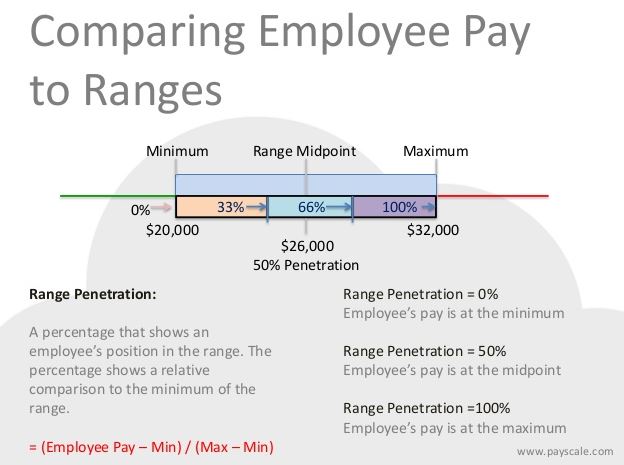
Salary Range

Let’s say a software engineer in Dallas is a band 7, which ranges from $50,000 to $150,000, where 50K is the minimum pay (min), 100K is the mid point (mid), and 150K is the maximum pay (max).  One might assume that 100K is the 50th percentile, but it may not be.  It may be the 80th percentile.  While I assume it’s possible, I have never seen it be the 30th percentile.  What this is saying is that companies may be willing to pay the full range for certain exceptions, and they need a wide range to keep them within their own regulations, they have a preference for paying at the front half (min to mid) and let the back half (mid to max) be used for merits over time or internal moves from other roles that may have higher pay in the market, but fall within the same pay band within the company.  Most companies target the 50-80th percentiles as the sweet spot in which they do not bring someone into a band over.  Also, some companies will not bring an external hire into a band lower than the 30th percentile, except in rare occasions.  The most common people in the lower 30% of a band are those who were internally promoted and their salaries were way below the band minimum, so they get a significant increase just to get them to band minimum.  This increase is usually 5 to10% more than their prior salary, and thus deemed suitable for a promotion.  If their previous band + 5% to 10% increase puts them higher in their future band than minimum, then the company average % increase usually wins, up to 50-80% of the band.

An entry level person in that role (new to the role) with no experience in that role (you can have years of experience in other roles, but if you have none in that role, then it may not help you), will usually be brought in between the 30-50th percentiles.  Once you add experience or skills, then you can work your way from the 50-80th percentiles.

Companies typically earn a bucket of funds towards merit increases.  If a company did not perform as expected, then those funds were not earned at the rate that was expected.  For instance, if a company plans for a 4% merit (which basically counteracts US inflation)

I’ve seen many companies be able to pay externals higher rates than internals.  And some companies create processes that inadvertently prevent HMs from paying internals as high as externals, even if they wanted to.

So what does this mean?!?  A person looking to make the biggest financial increase, is more likely to make more money leaving their current place of employment and starting work elsewhere than if they stay in their job locally.  In fact, the best way to get your work salary up would be to job hop 2-3 times across companies in the same role, then get a promotion, and then do it again.

That’s a problem for corporate America.  Employers want to retain employees, especially good ones.  The cost of replacing an employee has traditionally been 1X their annual salary.


What should employees do?

Be educated and realistic.  Don’t use salary.com and other online salary tools to explain to your boss what you are worth, unless you know how to use it properly.  Meaning, average salary anticipates tenure within a role.  If you don’t have 5-10 years experience in that exact role and you’re not in the exact location that the online tool quoted, then you’re not comparing apples to apples.  Instead, determine what you are worth to your company based on an understanding of your company’s pay grades, in some companies this can be retrieved through HR.  If compensation information is not shared internally, then determine your worth based on your improvements and additional value add since your last salary negotiations.  After all, at one point, you agreed to making a salary at that company.  It may have been the day you were hired, but there was a starting point.  Don’t negate your years of experience within that company.  Experiential knowledge within a company makes you very valuable to them.  Being willing to share your knowledge with others without fear of losing your job makes you even more valuable.

Inform your manager of your salary concerns early, months before you need a raise.  And be empathetic with your boss when they cannot get you a raise immediately.  More and more employers are only offering promotional level increases during the annual merit cycle.  If you wait until then, it’s too late.  The merit and promotional process can sometimes begin as early as 3 months before employee notification, and if companies have had challenging net profit years, then they could even be set the year before, when well deserving employees were not able to get the raise that managers fought for.

Be honest with your employer.  Let them know you’re looking and other options (if you are), and what you will make outside.   Some employers want to do raises, but can only do them if there’s a significant risk if you will leave without one, such as you having an offer on the table.  Employers may have a hard time getting a mid-cycle raise approved, but they can often process a counter offer to retain an employee.

If you’re really interested in earning what you’re worth, check out my article on the topic.


So what should companies do?

Unfortunately if everyone followed the tactics above, it would be very hard on companies because they don’t budget for promotional increases.  If everyone got a yearly promotion, and fewer people retired, and newer people were requiring more from the start, then corporate inflation would wreak havoc on our economy.  But there are things we can do to be fiscally responsible.

First off, treat employees fairly.  Fair does not mean oiling the squeakiest wheel because it’s easier on you to make one very vocal person go away, while ignoring the mass of people who don’t have the skill of being bullish.  Some people who want raises are too afraid to talk about money, but less afraid to take another job elsewhere – and we’ve already mentioned that’s very costly to the company.  Instead, work hard to create fair pay scales where increases within the range are based on specific skills and experience, and make that public knowledge, at least within the company.  If employees have a list of 5, 10, or even a hundred things they need to achieve for the raise, they will do it.

Second, once you publish the rules, follow them yourself too.  Don’t waive a carrot and then not offer it up when the agreed upon time arises.  Don’t cherry pick who will be next, without explaining why to anyone in the running.  When passing up an employee for a raise or promotion, give them clear indication of what they need to do, and in what timeframe, for them to see their monetary rewards.  And once they do it, act upon it.


When to go electronic, phone or face to face

In an increasingly electronic world where social media is a buzz word, we’re constantly being asked to replace costly travel with electronic meetings.


What questions can we ask that may help us determine what kind of meeting is suitable?

  1. Will there need to be an action reaction volley?  An action reaction volley will be when based on one decision and action pair, another decision and action pair is made, which initiates another decision and action pair.

Yes –> face to face

No –> phone/electronic

2. Is there room for misinterpretation?

2a. Yes –> Is it a difficult message?

            Yes –> Phone or in person

            No –> electronic, phone, or in person but be sure to get confirmation of understanding

2b. No–>

Is it a difficult message?

Yes –> Phone or in person

       No –> electronic

RPO is like surgery

I had a client once say, “I need more hand holding.  You guys have done this a thousand times, but I have never done it.”  Then what she said next, turned on a lightbulb: “Think of yourself like the surgeon and I’m the patient.  Please tell me what’s going to happen and help me relax over it.”

Wow.  Ok, so I’m not saving lives directly – but I believe I am still enabling lifesaving connections somewhere along the line.  I build teams that hire the next innovators, next product launchers, next hospital doctors and nurses, next pharma developers.  Maybe, just maybe, I enabled the team that hires the team that cures cancer!

Now I’ve clearly never been a surgeon, but I imagine they go through lots and lots of training, and then they do some sort of rotational residency before they can practice.

I’ve been in RPO for nearly 20 years – we didn’t call it RPO back then, but we still managed the entire recruitment functions of other corporations to make direct placements within those corporations.  I’ve been training for a long time.

And I’ve done my rotational.  I’ve been an admin, a coordinator,  a searcher or sourcer, a business analyst, a recruiter, a consultant, and a manager of ALL those teams.  I’ve even been the technology SME and administrator and product developer.  I’ve owned client P&Ls and County P&Ls.  And if needed, I put on my janitor gloves and clean up.  I’ve worked with hundreds of clients.

I’m not entirely unique.  The most successful people in implementation have experience in multiple facets of RPO because we must know a little bit about all of it.  But we don’t have to be an expert in everything.  Just as the surgeon is expected to confer with other specialists, we do too.

I imagine every surgery has some similarities and differences.  Building an RPO does too.  No two RPOs should be exactly alike.  If they are, we’re not serving our clients unique needs.

We have to understand our patient’s history, know what their desired outcomes are, and sometimes prescribe some pre-surgery medication that the patient isn’t excited to take.

When a new implementations person comes to me, they want to be trained.  I tell them, “Great!  Give it time and you’ll learn everything you need, but first, you need to be the understudy”.  We work in gray and there is NEVER a client that went exactly as planned.  I imagine surgeries are are more routine than building RPOs, but every now and again, I suspect something unexpected happens.  How does the surgeon address it?  It’s via years of training in other areas so that when the unexpected happens, the surgeon’s instincts kick in and they stop the bleed and move on.