

Data Privacy and Security continue to be on the rise. While we may all feel a little exhausted from GDPR, it is not losing traction. In fact, more and more states and countries are joining in. In 2023, the US saw a surge in states joining the data privacy movement, with the California Privacy Rights Act (CPRA) leading the way, quickly followed by the Colorado Privacy Act (CPA), Connecticut Data Privacy Act (CDPA), Utah Consumer Privacy Act (UCPA), Virginia Consumer Data Privacy Act (VCDPA), Florida Digital Bill of Rights (FDBR), Oregon Consumer Privacy Act (OCPA), Montana Consumer Data Privacy Act (MCDPA), and many others. 2025 already has Iowa, Texas, Delaware, Tennessee, and Indiana on the docket. It’s not just US who is standing with the UK on this, other countries including Switzerland, Israel, Qatar, Turkey, Japan, Argentina, Brazil, and Canada have all implemented similar laws. China’s recent PIPL laws has TA companies scrambling to review how they store China’s data.
https://www.reuters.com/legal/legalindustry/us-data-privacy-laws-enter-new-era-2023-2023-01-12/
https://www.dataguidance.com/comparisons/usa-privacy-laws
Companies are becoming increasingly reluctant to integrate any Personally Identifiable Information (PII) into technology. This goes beyond the SPII restrictions of old (for example beyond birthdates and country IDs) to include names and even company email addresses. This creates a tricky environment for balancing the tech-forward needs of the digital era with the privacy and security needs of the GDPR era. Will our personal data be part of some sort of blockchain algorithm in the near future? Only time will tell.
Speaking of the future, AI is on the rise! Those worried about AI taking their jobs should be, not because the technology is so advanced that robots will be doing their job, but because if they aren’t keeping up, they will be left behind. Think of AI like the invention of the computer. People with typewriters and filing systems were reluctant to migrate over to computers, but the fact remained that computers were faster, so eventually, everyone migrated. Even then, it took years for people to stop printing out everything they created. AI is the same; it will take years for adoption. But if you aren’t an early adopter, you will be left behind because with machine learning, the growth of AI will accelerate exponentially faster. Like computers, AI has both good and bad potential. What is clear is that companies need to race to identify what AI they will use, and more importantly, how they will govern AI in their business. States and countries need to determine what parameters they will put around AI to keep their citizens safe.
In 2024, the skills gap is rising, so companies are turning to Skills-based Hiring and focus on learning & development. The situation is real. Consider this:
The US private Employment is back to pre-pandemic levels

Source: ADP Research Institute https://adpemploymentreport.com/
Unemployment is down to 3.7% (Dec 2024)

Source: Bureau of Labor Statistics https://www.bls.gov/charts/employment-situation/civilian-unemployment-rate.htm
So with jobs up and unemployment down, it’s a candidate’s market again, right? Wrong! What’s happening is that there is a significant skills gap, with not enough qualified people for the jobs that are available. In addition, those who are qualified have different work requirements than in a pre-pandemic world, as they are more aware of the impacts of mental health and other factors that drive personal and professional satisfaction. We are seeing the impacts of #MeToo and social injustice awareness, causing a magnifying glass on company policies. Companies know they must treat their employees better than in years past in order to retain them. Retention and management practices are definitely factors on CHROs minds. But it’s the skills gap that is creating the most immediate needs. Employers are getting creative, replacing schooling and experience requirements with transferrable skills.
While this is all happening, we’re continuing to see a rise in the % of population retiring, as a result of the baby boomers reaching their retirement years.
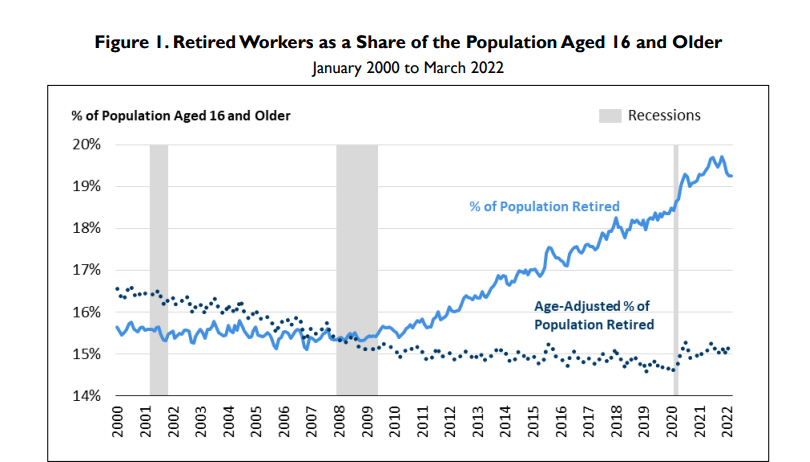
Source: Retirement Trends in United States, 2000-2022 https://crsreports.congress.gov/product/pdf/IN/IN11959
According to cbsnews.com, “2024 will be a record-breaking year for retirement in the U.S., with an average of 11,000 Americans a day expected to celebrate their 65th birthday from now until December.” https://www.cbsnews.com/news/retirement-medicare-401k-what-to-know-peak-65/#:~:text=2024%20will%20be%20a%20record,birthday%20from%20now%20until%20December.
Let that sink in. 11k per day.
When you add in the need to keep up with ever changing technologies, the skills gap will only continue to rise, and companies will have a new problem on their hands.
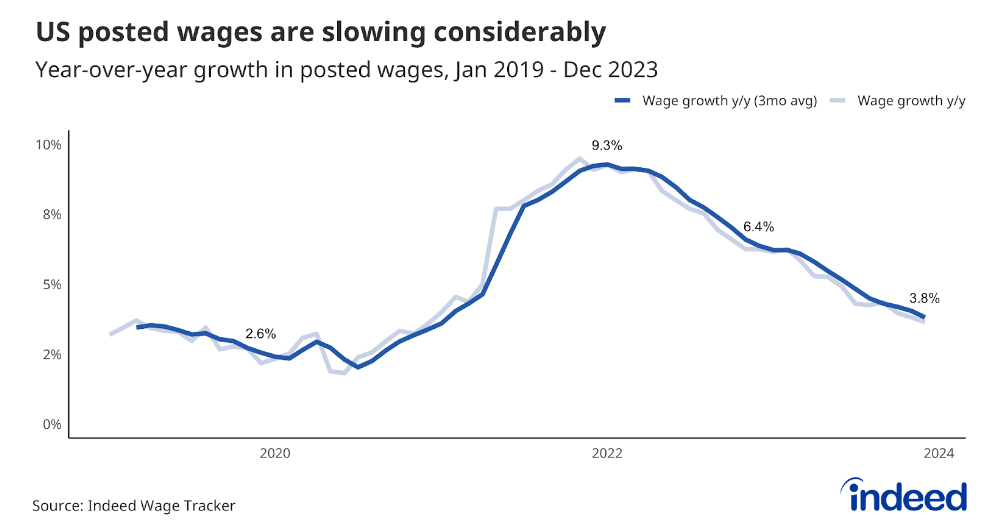
The good news is that the wage inflation that we saw in 2022 and 2023 seems to be slowing down. Bloomberg predicted it back in August that wage growth was slowing as inflation was cooling https://www.bloomberg.com/news/articles/2023-08-24/job-market-is-fed-s-ally-as-wage-growth-slows-down-indeed-says
And we’re seeing that continue to play out according to Indeed.com
So what does this all lead to? As a result of the current landscape, you can expect change burnout, and TA companies hesitant to do unnecessary technology reform. However, they will continue to do technology upgrades where necessary, such as implementing AI tools, to keep up with market demands. Instead of major overhauls, you may be more likely to see them move to more “merge” technology that allows them to bolt on to their existing infrastructure. Middleware, integration specialists, and change management specialists, get ready – 2024 is your year!
You can see more crack down on data privacy and security.
You will see a wave of advancements in AI, followed by a wave of pull backs as new legislation comes out that regulates that AI.
You will see more companies lower education and employment requirements and seek out skills assessments and education programs, as well as develop partnerships with schools to offer mini-education programs that are aligned with company skills gaps.
You will see companies trying to drive employee retention, but employees continuing to job hop in search for better wages and greener pastures. As a result, companies will have to adjust and turn to an even wider temporary and contractor base to fill in those gaps.
What else are you expecting to see? I’d be very interested in hearing from you.
Check out these other great articles about TA and HR trends for 2024:

 MintROI